
Ask any Miami homeowner what the worst possible time for an AC breakdown is, and they’ll all give you the same answer: July. August. Basically anytime between Memorial Day and the tail end of hurricane season in November.
And yet every year, thousands of Miami households skip their spring AC tune-up Miami visit and roll the dice. Sometimes they get lucky. Often they don’t ending up with an emergency service call on a Saturday in August when every HVAC tech in Miami-Dade is already booked out for days.
This guide is specifically for Miami homeowners who want to get ahead of hurricane season and summer heat. It’s not a generic “change your filter” article. Miami’s climate is specific, and your pre-season checklist should be too.
Why Hurricane Season Changes the Equation for Miami AC Systems
Most pre-season HVAC guides are written for the whole country. They tell you to schedule service in spring, change your filter, and that’s basically it. For Miami, there are several layers that those guides don’t cover:
Salt Air Corrosion
Miami’s coastal location means elevated salt content in the air particularly in neighborhoods near Biscayne Bay, South Beach, Key Biscayne, or anywhere in the eastern corridor. Salt accelerates corrosion on outdoor condenser coil fins, electrical components, and metal cabinet parts. A pre-season check should include inspecting for salt-related corrosion, especially on units 5 years or older.
Storm Debris and the AC Unit
Every storm season brings the risk of flying debris, power surges, and flooding around outdoor condenser units. A pre-season tune-up should include making sure your condenser pad is level, that the unit is not surrounded by plants or debris that could restrict airflow during a storm event, and that the electrical disconnect is in good condition.
The 12-Month Operation Problem
Because Miami AC systems run essentially year-round, they accumulate 3 to 4 times the annual wear of systems in cooler states. A component that would last 8 years in Minneapolis might last 4 to 5 in Miami. Catching a failing capacitor in April costs $200. Catching it after a breakdown in August means waiting in line behind hundreds of other homeowners with the exact same problem.
The Pre-Hurricane Season AC Tune-Up Miami Checklist
Here’s what a professional AC tune-up Miami should cover and what you can check yourself before the technician arrives:
What You Can Check Before Calling
- Change your air filter: Use MERV 8 to 11 for Miami homes. Replace it even if it doesn’t look dirty; in high-humidity environments, filters trap moisture and bacteria before they’re visually saturated
- Clear 2 feet of space around the outdoor condenser: Remove any plants, debris, or overgrowth that accumulated over the cooler months
- Check your condensate drain line: Pour a cup of water down the drain pan; if it doesn’t drain freely, the line is partially blocked and needs clearing before summer
- Test your thermostat: Set it to cooling mode and make sure the system responds within a few minutes
- Listen for unusual sounds: Clicking, grinding, or rattling when the system starts up are early warning signs
- Check your vents: Make sure all supply and return vents are unobstructed by furniture
What a Professional AC Tune-Up Miami Covers
- Refrigerant pressure check :Low refrigerant is one of the top causes of reduced cooling efficiency in Miami homes. It indicates a leak that needs to be found and repaired, not just topped off
- Capacitor testing :Capacitors are among the most common components to fail in Miami due to continuous operation. A weak capacitor that’s tested in April costs $150 to $300 to replace. A failed capacitor in August costs more plus emergency service fees
- Contactor inspection :The contactor switches power to the compressor and fan. Miami’s heat causes these to wear faster than average
- Evaporator coil cleaning :Dirty evaporator coils reduce cooling efficiency and promote mold growth. In Miami’s humidity, this is not optional
- Condenser coil cleaning :Outdoor coils collect debris, salt residue, and pollen. Dirty coils make your compressor work harder
- Condensate drain flush :In Miami’s humidity, drain lines clog with algae and mold regularly. A clogged drain causes water backup and can trigger system shutdowns or water damage
- Blower motor and wheel inspection :The blower circulates air through your home. Worn bearings or an unbalanced blower wheel reduces airflow efficiency
- Thermostat calibration :Thermostats can drift over time, causing your system to run longer than necessary
- Electrical connections check :Loose connections are a fire risk and reduce efficiency
- System performance test :After servicing, a full operational test ensures the system is cycling correctly and achieving target temperatures
How Much Does an AC Tune-Up Cost in Miami in 2026?
This is the question everyone wants answered directly, so here it is: a proper AC tune-up Miami costs between $99 and $500 in 2026, depending on what’s included and who you hire.
A $99 to $200 option usually covers a basic inspection and a few checks good for a newer system that’s been well maintained. A $300 to $500 option typically includes the full checklist above, refrigerant pressure testing, and coil cleaning.
What you want to avoid is the $29 or $39 special. These are almost always loss leaders designed to get a technician into your home so they can find additional “critical” repairs. If someone knocks on your door offering a $29 AC tune-up, ask them what specifically is included. If they can’t name 8 to 10 distinct tasks, it’s not a real tune-up.
At David Solutions Air Conditioning, our tune-ups are written estimates before work begins. You know the cost, you know what’s being done, and nothing starts until you approve. That’s how we’ve operated since 1993.
Signs Your System Needs More Than Just a Tune-Up
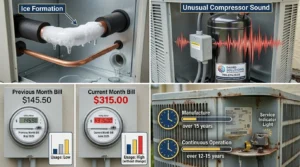
Sometimes a pre-season inspection reveals that a system needs more than maintenance. Here are the signs that a AC repair Miami call may be needed before summer, rather than just a tune-up:
- The system isn’t reaching the set temperature even after filter replacement
- There’s ice forming on the refrigerant lines or indoor air handler
- The compressor is making grinding or screaming sounds
- Your electricity bills have increased significantly without any change in usage
- The system is older than 12 to 15 years and has been running continuously without maintenance
If any of these apply, call before summer arrives not during it. A system that’s marginal in May will likely fail in August.
When Is the Best Time to Schedule Your AC Tune-Up in Miami?
HVAC companies in Miami are significantly less busy in late winter and early spring than they are during peak summer heat. You’ll get faster scheduling, and more importantly, any parts that need to be ordered won’t take as long. If your technician finds a failing compressor in April, you have weeks to source and install a replacement. Find the same problem in July and you might wait while supply chain backlogs stretch lead times.
The second-best window is after hurricane season, between October and November, to clean up any system damage before the holidays.
Take Care of It Now, Not in August
Miami’s summer heat is not a joke. When your AC fails in July, it’s not just uncomfortable it’s a genuine health risk, particularly for older residents, young children, and pets. An annual or bi-annual AC tune-up Miami routine is one of the highest-return maintenance investments a Miami homeowner can make.
If you want to schedule a pre-season tune-up before Miami’s heat peaks, explore our full range of air conditioning services Miami at davidsolutionsairconditioning.com, or call David Solutions Air Conditioning directly at 786-674-1548. We serve all Miami-Dade County neighborhoods, and our team is available 24/7 for any emergency AC repair Miami situations that can’t wait.